/

Selected work

Crawford & Company: Design system

Strategies · UI development · 0–1

Crawford & Company: Design system

Strategies · UI development · 0–1

Role

Lead Designer

Role

Design, Engineering, Applied Science, Product

Role

Lead UX Designer

Timeline

2 years

Timeline

2 years

Timeline

2 years

Team

Design, Engineering

Team

Design, Engineering

Team

Design, Engineering

Scope

Design, UI development, Project management

Scope

Design, UI development, Project management

Scope

Design, UI development, Project management

Impact

Built a design system (design + vanilla code) from scratch; achieved 27.9% SUS increase and 4.2-point NPS boost

Impact

Built a design system (design + vanilla code) from scratch; achieved 27.9% SUS increase and 4.2-point NPS boost

Impact

Built a design system (design + vanilla code) from scratch; achieved 27.9% SUS increase and 4.2-point NPS boost

Establishing design standards for offshore software development
Establishing design standards for offshore software development

Establishing design standards for offshore software development

Crawford & Company is a global third-party administrator managing workplace injury claims for corporations like FedEx and McDonald's. The company relied on offshore development for its claim management tools.

As the company scaled, leadership viewed the core problem as IT debt: legacy technology was retiring. But the real issue was operating risk. A single claim adjuster worked across all three systems, rebuilding context every time they switched and tracking data manually while managing highly confidential personal health data. They didn't need better-looking systems. They needed a unified workspace where every interaction was predictable and every piece of critical data was easy to find.

I joined as the company's first designer to build the design system from scratch — building blocks and guidelines for offshore teams to develop software with higher usability and velocity.

Crawford & Company is a global third-party administrator managing workplace injury claims for corporations like FedEx and McDonald's. The company relied on offshore development.

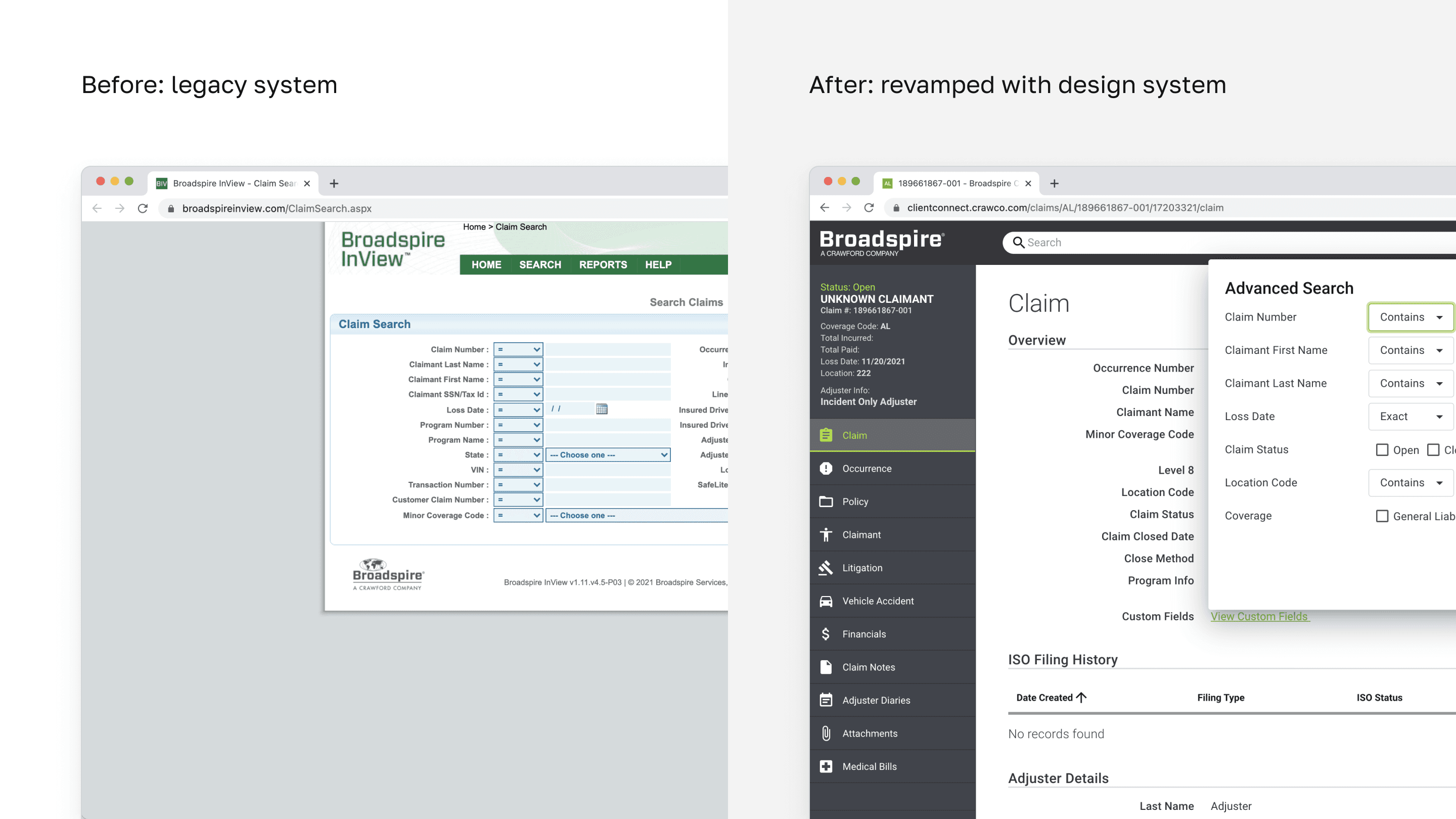
As the company scaled, leadership viewed the core problem as IT debt: legacy technology was retiring. But the real issue was operating risk. The same claim adjusters worked across all three systems, rebuilding context every time they switched and tracking data manually while managing highly confidential personal health data. They didn't need better-looking systems. They needed a unified workspace where every interaction was predictable and every piece of critical data was easy to find.

I joined as the company's first designer to build the design system from scratch — building blocks and guidelines for offshore teams to develop software with higher usability and velocity.

Crawford & Company is a global third-party administrator managing workplace injury claims for corporations like FedEx and McDonald's. The company relied on offshore development.

As the company scaled, leadership viewed the core problem as IT debt: legacy technology was retiring. But the real issue was operating risk. The same claim adjusters worked across all three systems, rebuilding context every time they switched and tracking data manually while managing highly confidential personal health data. They didn't need better-looking systems. They needed a unified workspace where every interaction was predictable and every piece of critical data was easy to find.

I joined as the company's first designer to build the design system from scratch — building blocks and guidelines for offshore teams to develop software with higher usability and velocity.

The design system scaffolded the transformation from legacy to a unified multi-tenant workspace.

Design, code, and guidelines built for offshore constraints

Design, code, and guidelines built for offshore constraints

Design, code, and guidelines built for offshore constraints

A design system is more than UI elements. It integrates design, code, and guidelines to improve development quality and speed.

Crawford relies on offshore staffing to reduce costs. The design system had to support this reality in two ways:

1.

Minimize dependency

Limit external libraries and reduce extra JavaScript to lower maintenance needs and avoid issues when third-party libraries fail.

1.

Minimize dependency

Limit external libraries and reduce extra JavaScript to lower maintenance needs and avoid issues when third-party libraries fail.

1.

Minimize dependency

Limit external libraries and reduce extra JavaScript to lower maintenance needs and avoid issues when third-party libraries fail.

2.

Strict nesting CSS rules

Offshore teams focus on speed over quality. We baked layout and theme rules to parent and utility containers, giving clear and limited modifiers to control the shift from design to code.

2.

Strict nesting CSS rules

Offshore teams focus on speed over quality. We baked layout and theme rules to parent and utility containers, giving clear and limited modifiers to control the shift from design to code.

2.

Strict nesting CSS rules

Offshore teams focus on speed over quality. We baked layout and theme rules to parent and utility containers, giving clear and limited modifiers to control the shift from design to code.

Component example: grid system

For the first six months, we had no frontend engineer. I learned and wrote production-ready vanilla code myself, while designing workflows to minimize discrepancies between design and implementation.

Component example: breadcrumbs

27.9% SUS increase and reduced dependence

27.9% SUS increase and reduced dependence

27.9% SUS increase and reduced dependence

The design system modernized three legacy applications. SUS scores increased by 27.9%, NPS rose by 4.2 points, and the team reduced dependence on offshore engineering resources.

Beyond components, I established the processes that made the system sustainable: design token automation, a frontend development workflow between designers and engineers, usability testing standards, and documentation that enabled offshore teams to implement with minimal supervision.

Thanks for stopping by ㋡.

Minshuo Tang © 2026

Thanks for stopping by ㋡.

Minshuo Tang © 2026

Thanks for stopping by ㋡.

Minshuo Tang © 2026